
Do plants purify the air in our homes?
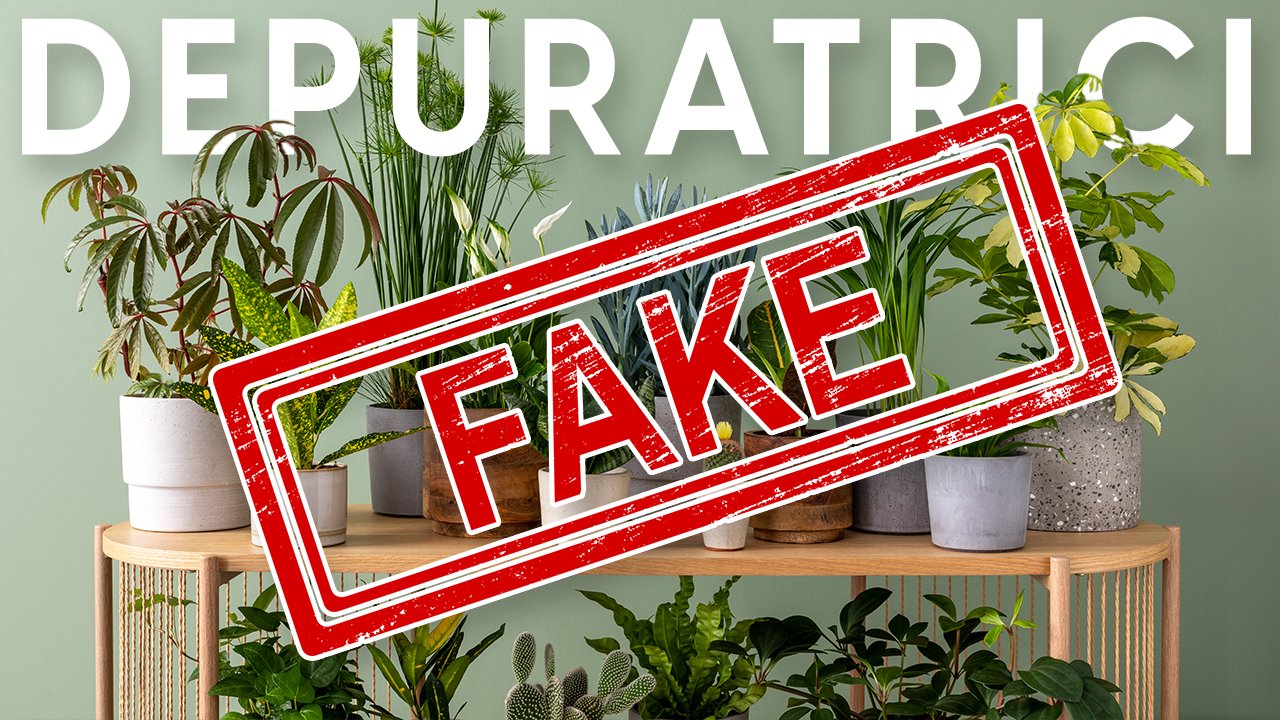
This topic deserves further investigation in light of the objections that have recently been raised regarding the interpretation of the data coming from one study carried out by NASA (the American space agency) during the 1980s and which I talked about in a previous post from a few years ago. The experiment was conducted in order to understand whether plants could have potential in limit the presence of toxic volatile organic compoundsthe so-called VOCs or volatile organic compounds), such as benzene or formaldehyde (I imagine there was an interest in extending any positive results to the aerospace sector). VOCs, commonly present in domestic and work spaces, appear to be involved in health problems with non-specific symptoms known as sick building syndrome (SBS) or Sick Building Syndrome (for further information): irritation, redness, discomfort, which sometimes affect people after staying inside buildings. So here are the 12 best plants to purify the air and its myth.
The NASA plant experiment, in a nutshell
A dozen plants were tested (including: Aglaonema, Sansevieria, Dracaena, Ivy, Spathiphyllum and other common houseplants) placed for 24 hours in small airtight Plexiglas chambers into which pollutants were introduced: formaldehyde, trichlorethylene (TCE) and benzene.
After 24 hours the measurements provided apparently interesting results (see the tables below) in particular on initial concentrations of VOCs similar to those potentially found in closed environments such as homes and offices.
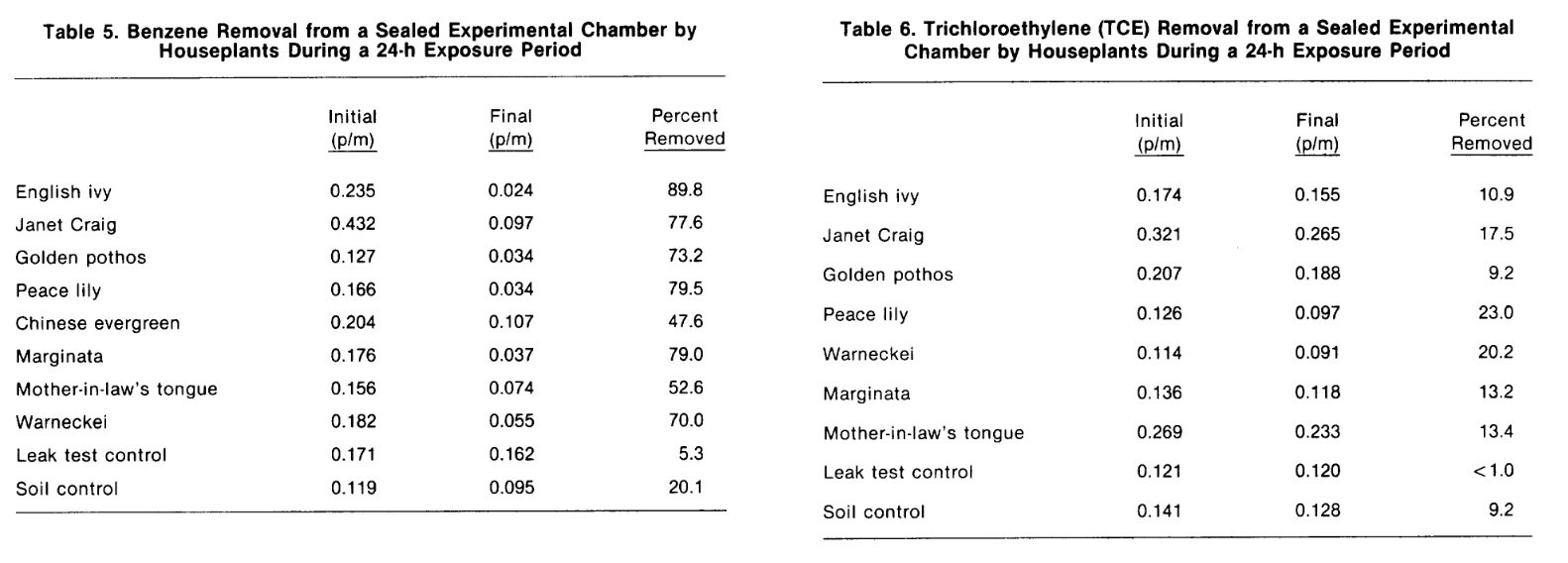
The data show variable reductions, depending on the plant used, between 50% and 90% for benzene and between 9% and 23% for TCE.
The birth of the myth: plants as air purifiers
The authoritativeness of a source like NASA and the sensational result that emerged led the media to report this information with emphasis, often neglecting some fundamental details, and in a short time the articles describing the species and varieties used in the space agency’s tests as ‘purification plants’ multiplied.
After years of enthusiastic faith in the above results, other experiments have been conducted in this direction, without however reaching even remotely the same conclusions that NASA tests suggested. This is not because the aforementioned tests were poorly conducted but simply because the media preferred the ‘bombshell’ to the correct contextualization of the data.
Criticisms of interpretations of NASA results
In fact, there are several clarifications that cannot be excluded from an objective analysis of the results emerging from NASA tests. Here are the ones in my opinion that deserve particular attention:
- The twelve plants used in the tests are NOT (as is often read) plants capable of purifying the air of pollutants: they are just the ones that NASA arbitrarily chose to use in a random manner. There wasn’t a particular choice upstream (for example because a certain ‘purifying’ capacity was already recognized in these species in light of previous studies). Potentially, we could see the same (or even better) results using a Philodendron or Strelitzia – who knows?
- Looking at the tables above, you can see that the last line shows the effectiveness in reducing VOCs of an empty earthen pot, without a plant: in terms of benzene and TCE, 20% and 9.2% respectively. A very interesting fact (it tells us that Soil microbial activity plays a large role in the sequestration of volatile organic compounds under examination) which should however be deducted from the percentages attributed to the plants, tested in the airtight chambers together with the earthen pot which housed the roots.
- THE’testing environment was too limited in order to assume that the same effectiveness in the purifying action could be automatically transferred to a real environment: the airtight chambers in which the tests were carried out measured 0.44 and 0.88 cubic meters (practically boxes), volumes very different from those of a room at home or an office where in fact the same results were not replicated.
- Unlike what happens in a real environment, volatile compounds were only placed in the test chambers at the beginning of the test. What happens in an office or a living room, however, is very different: the production and release of these compounds into the air is continuous and not punctual.
- We often read that plants can reduce 90% of pollutants but this percentage emerged from only one test (Ivy and benzene), with all the limitations in the interpretation of the data exposed in the previous points. They exist hundreds of harmful volatile compounds that have not been tested and therefore this conclusion is completely unfounded. Even in this case it was done cherry picking taking the most surprising fact and generalizing it to all plants and all toxic volatile compounds.
The topic of activated carbon filters
I conclude the analysis of the NASA test with a pair of graphs that illustrate how the plants tested were able to eliminate or almost eliminate the presence of VOCs (benzene and TCE) in the test environment and in just 2 hours!
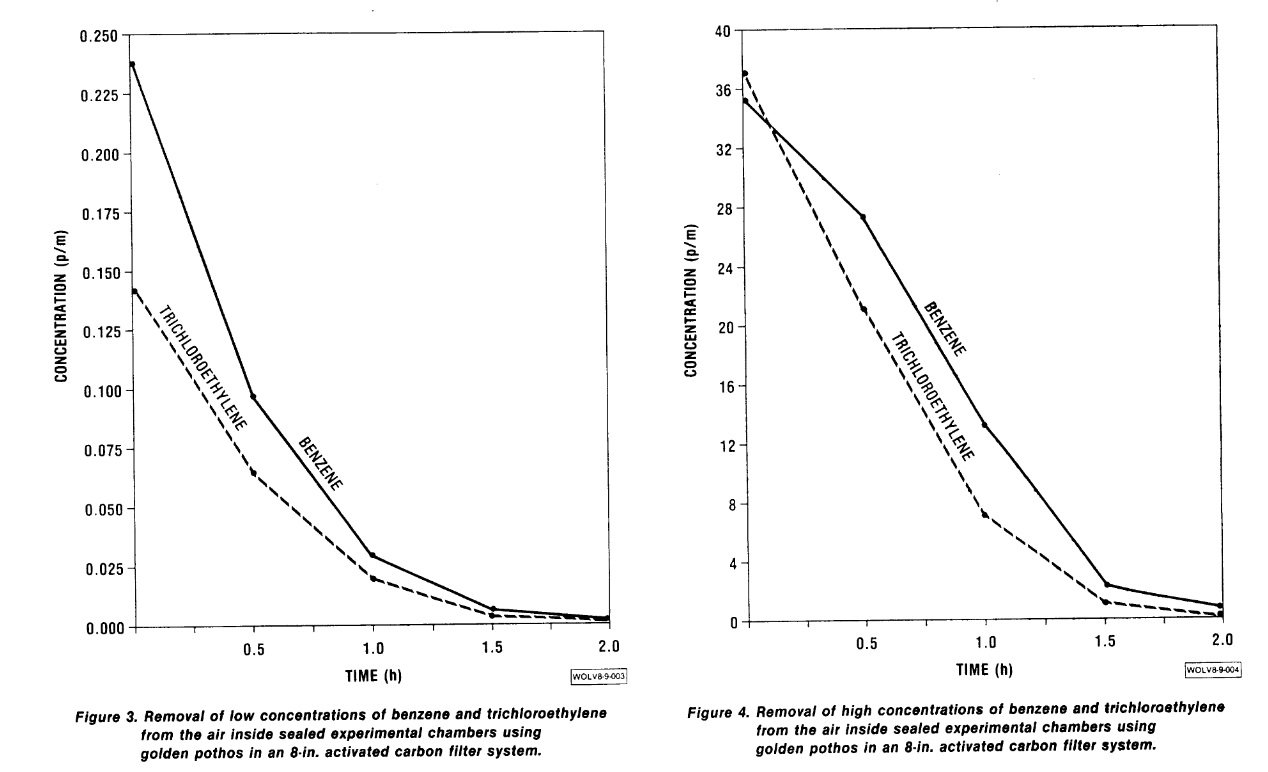
By carefully reading the article (but also just the captions) it emerges that this test was conducted using plants inserted on a substrate of activated carbon and inserted into a device equipped with a fan to force the entry of air into the system, allowing the plant-charcoal apparatus to process an enormously greater volume of air in the same unit of time.
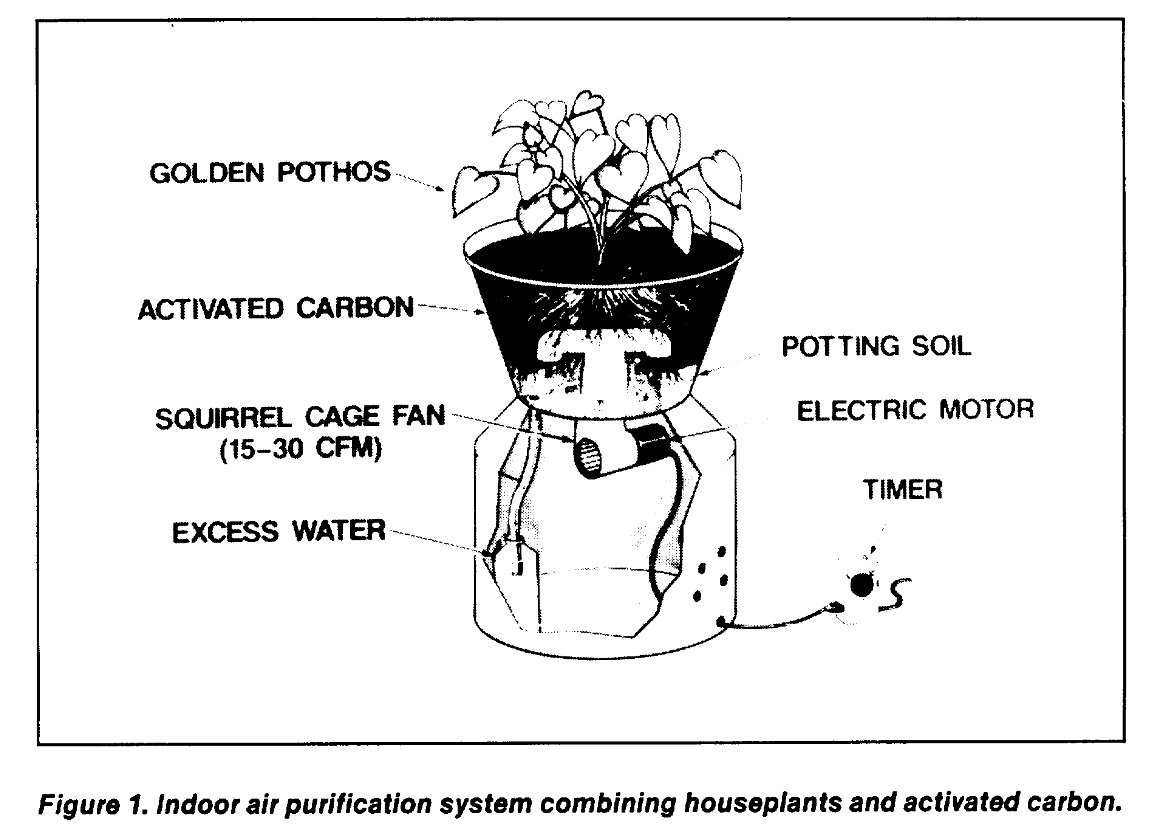
A test that I consider absolutely interesting because the quantity of air processed autonomously by the tissues of a plant is very low compared to that involved, for the same amount of time, in human breathing or in the functioning of an internal combustion engine. As I explained in the article ‘are plants in the bedroom bad for you?’ when we talk about plants the quantities involved are orders of magnitude lower than we would imagine.
However, the test is very interesting: activated carbons block volatile organic compounds inside them and the plants absorb them and metabolize them, preventing their re-entry into the atmosphere. The plants therefore do not have a filtering role in this case but a ‘disposal’ role, carried out in the first instance by the absorption action of the root system. The leaves and their ability to absorb volatile pollutants are not the focus and it cannot therefore be said that the merit of sequestering them from the air should be attributed to them.
Recent studies on plants that purify the air
Over the years there have been numerous studies on the purifying power of plants against volatile organic compounds, potentially toxic to health. What we know today, in light of rigorous investigations, is that the presence of plants in a closed environment, whether domestic or work, is not capable of perceptibly improving the quality of the air.
These are the conclusions reached by a study published by Nature in the Journal of Exposure Science & Environmental Epidemiology which examined 12 previous studies carried out using airtight chambers of limited dimensions (such as those used in the NASA test) and the related 196 experimental results. By processing this data, the researchers were able to establish that on average a houseplant can deliver a quantity of clean air of 0.0023 cubic meters per hour. I say ‘on average’ because this number varies greatly (even orders of magnitude) depending on the plant and the experiment conducted. In conclusion: considering that in a building the natural exchange of air with the outside is approximately 1 m3/h, from 10 to 1,000 plants per square meter of surface would be necessary in order to obtain a VOCs removal rate comparable to that which the normal exchange of air between inside and outside already provides in a common building.
Our homes are quite permeable and air constantly flows in from outside. This reduces VOCs levels much more effectively than plants.
latest posts published
Spring in stock: Preserve wild herbs and use them year-round
Everyone really likes wild herbs!
How to make air layering on indoor plants
Distances of trees from the border: what does the law say?

Month of Festivals, Traditions and Taste

🌿 The cold is coming! How to transform the living room into an autumn relaxation corner
From Amaryllis bulb to plant: complete guide!
how to take care of it » Sell Plants Online
Here are the 12 best plants to purify the air (but it’s all false)