With the arrival of spring and the warmer season, flowers and colors that have lay dormant underground for months bloom once more in the garden. Overwintering in the soil is one of the most successful adaptations of perennials—plants that, due to their almost herbaceous nature, would normally struggle to withstand harsh winters. But evolution has enabled them to recover and survive the cold winter using protective organs such as tubers, bulbs, and rhizomes. Although their above-ground parts wither or dry out during the cold winter, perennials can sprout new shoots every year, weather permitting.
There is far too little discussion about perennials. Today, I want to change that by introducing a type of anemone that blooms with rare and beautiful flowers in spring: the crown anemone (Anemone coronaria). First, I’d like to start with the origin of the name «anemone.»
ETYMOLOGY
The etymology of Anemone is linked to «someone refers to Anemos», this name was attributed to it by Theophrastus, a Greek philosopher and botanist and disciple of Aristotle. It is called this because it grows in windy open places, or because it opens at the first winds of the summer, or because it has a long stem, which the lightest breeze can stir by shaking the fragile petals.
TAXONOMY
The genus Anemone, to which A. coronaria belongs, is in turn part of the family of Ranunculaceae.
We have already talked about this genre and its division into groups in a previous post which you can retrieve from here. Anemones are in fact divided into three groups, one of which includes the spring/summer flowering tuberous species, normally typical of climates with hot and dry summers and found in the spontaneous flora of the Mediterranean area. And it is in this group that we find Anemone coronaria.
MORPHOLOGICAL DESCRIPTION
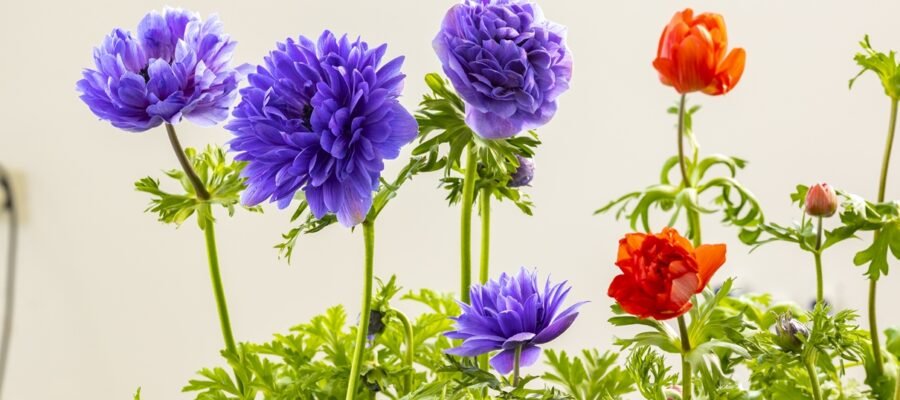
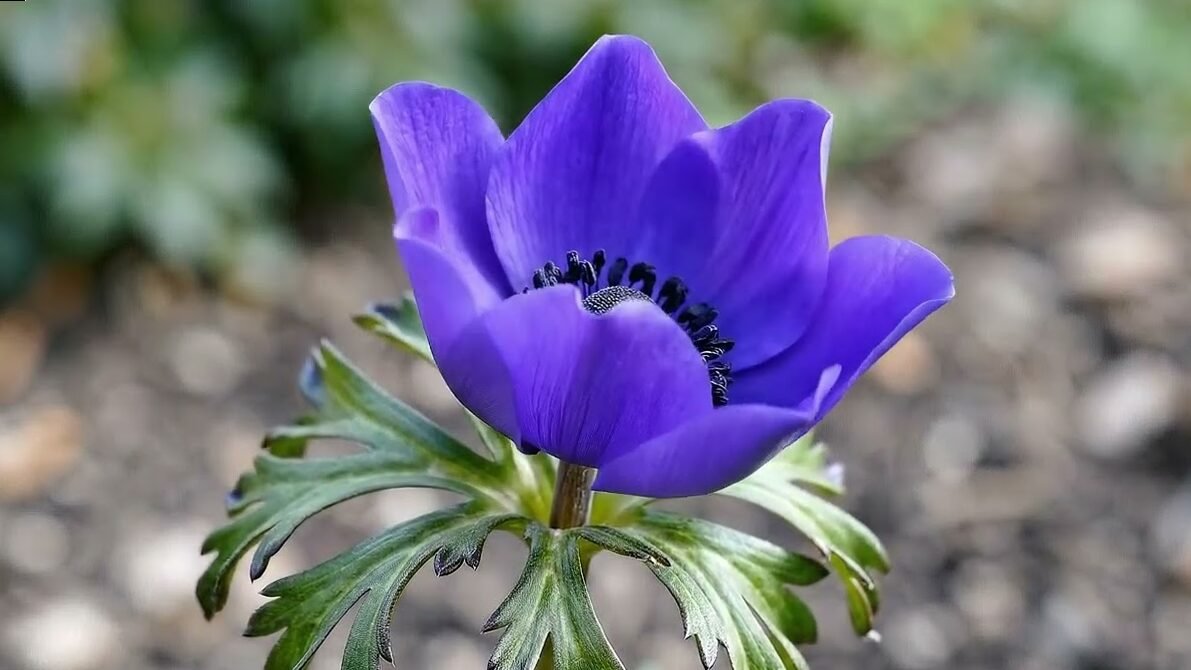
Anemone coronaria is an upright perennial with lumpy tubers and rounded to oval, tripalmate basal leaves and 5-12cm long cauline leaves with finely lobed leaflets. Simple, solitary, showy spring flowers, 3-8cm wide, with 5-8 red, blue or white tepals.
Anemones coronaria are grown for their openly concave to almost cup-shaped flowers, each with a central cluster of stamens. The flowers are solitary or gathered in cymes or umbels, on branched or unbranched stems.
Flower height: 30-50 cm
Plant width 15-20 cm
HABITAT
It is particularly widespread in the Mediterranean areas.
USE
In the flowerbed or planter, beautiful even as isolated specimens in small pots
CARE AND CULTIVATION
These wonderful flowers are considered rustic, therefore they do not require great care. Despite their apparent fragility, they know how to adapt quite well to their surroundings.
But let’s see how to make them feel really at home!
TEMPERATURE
It is a plant that does not particularly like the cold, late frosts can damage it, although it recovers quickly it is better to proceed with protection in the case of particularly low temperatures. The winter cold, however, does not affect it as it is at rest but a protective mulch is always welcome.
EXPOSURE
They adapt a little to all conditions, but the ideal is in areas of full sun or partial shade. Bear in mind that all full sun plants can also grow in partial shade conditions.
WATERING
The ideal is to keep the soil moist during the flowering phase, being careful not to overdo it or you could cause the rhizome to rot. However, when the plant fades, watering must be suspended in order to allow the plant to dry and prepare for the winter rest period.
SUBSTRATE
The rhizomes adapt easily to any type of soil, as long as it guarantees a good level of drainage. So the ideal is a light and sandy soil.
FERTILIZER
To help our anemones grow in strength, it is useful to give them a nitrogen fertilizer starting in March that can help them during their growth.
PROPAGATION
Propagation can occur via seed or by dividing the tufts.
PARASITES AND DISEASES
All species are vulnerable to nematodes, leaf spot and leaf spot, and are damaged by caterpillars and slugs.
PRUNING
Normally it does not require large operations as it has moderate growth. However, when it fades, it is advisable to cut the plant, eliminating the entire upper vegetative part, so that when vegetative growth resumes it can start from scratch.
TOXICITY
Anemones have a high toxicity due to the presence of alkaloids, the toxic glycoside ranunculin and various saponins.
SYMBOLS
The name Anemone derives from the gecko “ànemos”, meaning “wind”.
Anemones are the symbol of the ephemeral, of something wonderful but elusive. The roots of this myth derive from Ovid’s Metamorphoses who spoke of the anemone connected to the myth of Adonis.
latest posts published

Spring in stock: Preserve wild herbs and use them year-round

Everyone really likes wild herbs!
How to make air layering on indoor plants

Distances of trees from the border: what does the law say?

Month of Festivals, Traditions and Taste

🌿 The cold is coming! How to transform the living room into an autumn relaxation corner
From Amaryllis bulb to plant: complete guide!
how to take care of it » Sell Plants Online

Here are the 12 best plants to purify the air (but it’s all false)