
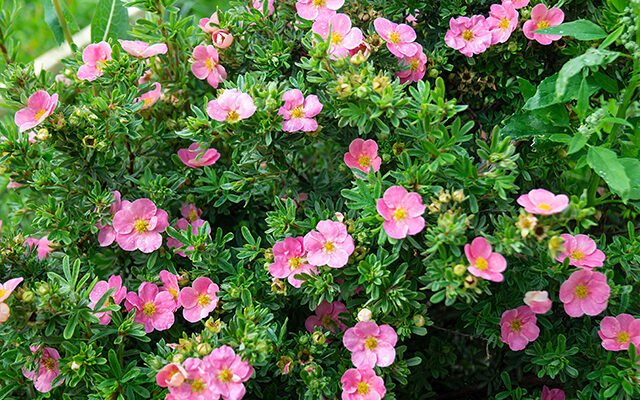
From May to autumn, the vibrant flowers of the shrub Potentilla fruticosa bloom in a breathtaking display. This shrub, growing to 30 to 90 centimeters tall, is impressive despite its small size, thanks to its striking ornamental value.
Its low-growing habit makes it ideal for flower bed edges, while its brightly colored flowers are sure to attract attention!
Potentilla fruticosa is a plant that is not demanding in terms of growing conditions, yet thrives in sunny locations.
Care of shrubby Potentilla
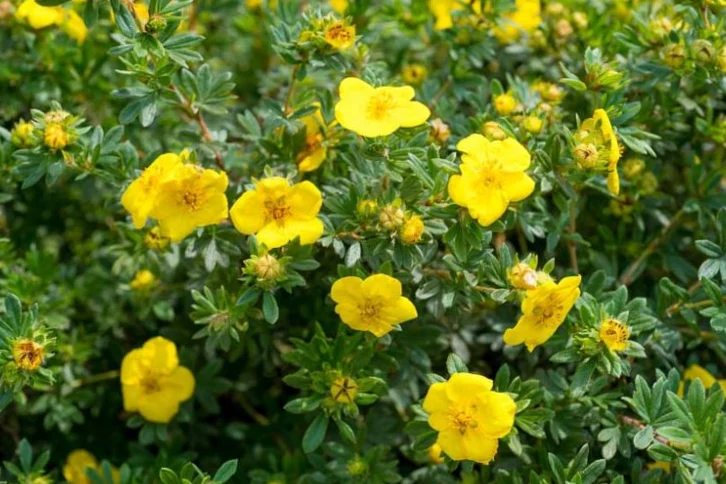
Potentilla is a shrub that requires low maintenance and, once established, requires even less 😉
Exposure
The Potentilla loves full sun and in general very bright areas, it also tolerates partial shade positions.
Temperature
It is very resistant to the cold, tolerating temperatures of -15°C.
Wetting
To encourage strong root growth it is important to keep the Potentilla well watered during its first year. After that the plant is hardy enough to tolerate drought, but will appreciate watering in particularly dry conditions.
To avoid various health problems for the plant, it is recommended to water only the roots and the soil instead of wetting the entire plant. Wet foliage and leaves can cause problems if they fail to dry completely.
Substrate
It prefers moist, fertile and well-drained soil but adapts well to any type of soil.
Fertilization
It is not very demanding regarding fertilization, in winter it is possible to fertilize with compost or organic fertilizer. In spring, however, it is recommended to administer slow-release granular fertilizer for flowering shrubs. The administrations should approximately be done in March, June and September.
Propagation
In the middle of summer it is possible take cuttings from the Potentilla. The ideal cutting is approximately 15cm long with woody stems.
It is also possible to propagate by seed but this practice is considerably more complex.
Pruning
It is not necessary to remove the flowers because they can manage themselves independently, furthermore due to its shrubby nature, the Potentilla takes well to pruning done to maintain its shape.
However, it is not recommended to prune before the plant is 3 years old, to be sure it can best resist the treatment.
Older plants should be pruned by about three of their total growth every few years to keep them healthy.
Pruning can be done at any time of the year but it is recommended the month of September to ensure optimal flowering the following year.
Parasites
It’s a lot resistant to insect attacks (although sometimes it turns out to be subject to unwelcome visits from aphids) and diseases. Be careful though: too much shade, lack of air circulation or excessive humidity can cause fungal diseases such as downy mildew, powdery mildew, rust and leaf spots.
Description
Potentilla fruticosa has deciduous foliage made up of 5 leaflets. The foliage varies from bright green to dark green, with palmate leaves.
Depending on the variety, flowering occurs from May to October.
Although predominantly Potentilla shrubs produce single yellow flowers, you can find many cultivars with color variations and some with double flowers. In addition to yellow, the colors that can be admired are: white, orange, pink and red.
Perennial, shrubby or both?
If you already know this plant, you may have noticed that sometimes it is reported as «perennial» and others as «shrub», who is wrong? Nobody!
Potentillas can be both perennial and shrubby, it depends on which species you are looking at. Here are some examples! In this article we talked about shrubby plants, but let’s also take a look at perennials.
Perennial potentillas
One perennial plant is *Potentilla alba*. It is characterized by its creeping stems, five-pinnate compound leaves, oblong to obovate-lanceolate leaves 2-4 cm long, light green on the upper surface and covered with silvery down on the lower surface. The flower heads are loose, cup-shaped, white, and about 2.5 cm in diameter. Due to its long flowering period, it is often used for flower bed edges or as a low hedge. Perennial plants can be cultivated year-round and can even tolerate lower temperatures. In winter, they enter a dormant period, resuming growth when temperatures rise.
Another perennial plant is *Potentilla atrosanguinea tomentosa*. Its leaves are tripinnate, dark green, 5-8 cm long, composed of 3-5 leaflets, which are ovate to elliptic or obovate in shape, with serrated edges and covered with silvery down. It forms a panicle inflorescence with saucer-shaped scarlet flowers, 3 cm in diameter, growing on an upright, slender, multi-branched stem.
Shrubby potentillas
Here we are instead at the shrubs, among which the Potentilla fruticosa stands out, small shrubs with deciduous foliage, which develop pinnate leaves, up to 4 cm long, composed of 5-7 oblong, dark green leaves. They produce saucer-shaped flowers, dark pink in colour, up to 4 cm wide, solitary or in peaks of 3, from May to October
Taxonomic description
It belongs to the Rosaceae family, the Potentilla genus is quite numerous, counting around 200 species.
Habitat
These plants grow in all temperate and cold regions of the Northern Hemisphere and on reliefs at lower latitudes. There are two species widespread in the Southern Hemisphere.
In our Alps they are widespread mostly everywhere, even at considerable altitudes.
Curiosity
The name “Potentilla” derives from the Latin word “potens” which means “healing properties” and from “illa”, meaning “small flower”.
This is because in ancient times medicinal properties were attributed to it.
latest posts published

How the chair influences the decor of a space

Ideas for decorating your home for Christmas
Winter fabrics for home decoration: ideas and advice
Furnishing farmhouses and barns: rustic elegance in Tuscany

Flos Portugal luminaires: sophisticated Italian design
Pedrali Outdoor: the complete guide to Italian furniture and design

Rugs and carpets – Tailored elegance and comfort

Design of the layout of the Miramaia Shopping Food Court

Comfortable chair or correct posture?