
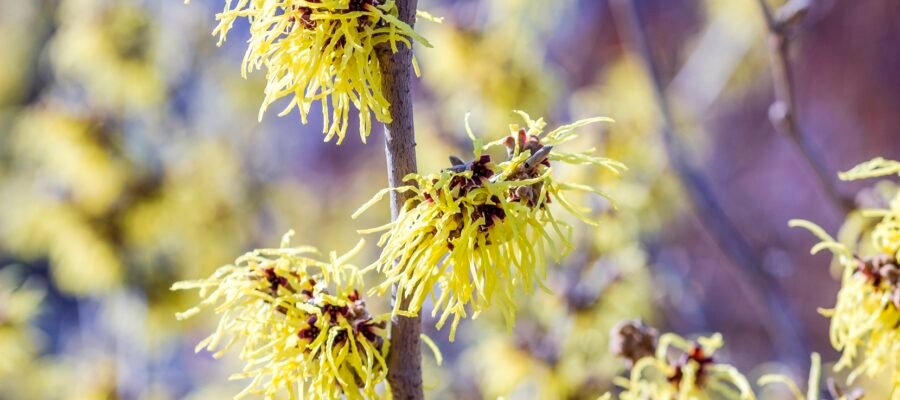
We recently wrote an article about the poetic viburnum (Calicanto), exploring how it tenaciously thrives in the snow, breaking the monotony of winter—at least that’s how it seems to us. Today, we want to introduce the witch hazel (which we’ve also covered in another article) in a similar way.
While the witch hazel isn’t the most well-known plant, it definitely deserves more attention! Admittedly, in summer, when its most distinctive features disappear, it looks like a hazelnut tree. Therefore, one might assume it lacks a strong personality, but that’s far from the truth. In winter, it reveals its full charm with its vibrant flowers. Unlike viburnum, its flowers can come in a variety of colors, from orange to red. Imagine strolling through a park, amidst a blanket of snow, and discovering a beautiful plant bursting with fragrant red blossoms. Doesn’t that already feel warm? Like a cluster of burning flowers blooming in the center of a cold, white blanket.
I don’t know what you think, but based on this alone, we feel that witch hazel (Hamamelis) is a plant that truly knows how to showcase its charm!
But to truly appreciate it, you must understand it deeply; you can’t forget that it’s only beautiful in winter! Okay, enough rambling, let’s get to the point!
HAMAMELIS
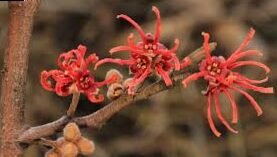
Hamamelis is one shrubby plantbelonging to the Hamamelidaceae family, a family which, in turn, includes six different species. The name Hamamelis undergoes some geographical transformations. For example, it is curious how in English it takes the name of «witch’s hazel«, because its trunk is used to produce the handle of what is, par excellence, the witches’ favorite means of transport: the broom. So, if you were looking for a beautiful plant for your mother-in-law’s garden, for heaven’s sake, avoid this one, you never know who will misunderstand.
Hamamelis is made in the USA and Canada, in particular it comes from the eastern regions of the United States, where not only is it very widespread as an ornamental plant but is also among the best-selling herbal products. To date, however, it has become a regularly cultivated shrub in Europe too, so it is not unlikely to see a specimen in our areas too.
The Hamamelidaceae family is not very large, as we were saying in fact it only has 6 elements. Most of these species are shrubby and deciduous plants, but there are some with an arboreal habit.
Among the most well-known and common species of Hamamelis we find Hamamelis virginiana (a very particular species that almost represents an exception compared to the others), Hamamelis japonica, Hamamelis vernalis and others. They are all quite similar (excluding Virginiana) so we focus on one species in particular: theHamamelis x intermedia, one of the most widespread hybrids in our country.
HAMAMELIS X INTERMEDIA
Witch hazel (Hamamelis x intermedia) is a deciduous shrub that can grow to 3-4 meters tall. Its flowers are small and intensely fragrant. The petals are delicate and silky, radiating outwards from the center. It is very hardy and can produce abundant flowers even in winter (some varieties, such as Virginia witch hazel (Hamamelis virginiana), have their earliest flowers blooming as early as September). The flower color changes from orange to coppery red, with the ‘Arnold’s Promise’ variety displaying a particularly beautiful and vibrant yellow. In autumn, when the witch hazel is no longer flowering, its large, oval leaves, with their irregular edges, remain brightly colored and are highly ornamental.
During the remaining months (except winter, when the witch hazel flowers but loses its leaves), the leaves retain a pleasing green (depending on the variety, it can be classic green, light green, or dark green). A unique feature of this plant is its fruit. The fruit develops from the flower, matures slowly, and may even remain until the next flowering season.
Another typical characteristic of witch hazel (Hamamelis) is its fragrance. All hybrid witch hazel (H. x intermedia) varieties are fragrant, but the fragrance varies from variety to variety. For example, the «Diana» variety has a fruity aroma, while the «Arnold Promise» variety has a damp mossy scent.
If you have a beautiful garden or a large terrace, why not try them all?
HOW TO GROW HAMAMELIS
The Hamamelis, with its decorative presence, it can be grown both in pots (in this case it will be necessary to pay more attention to watering, especially in summer) both in the garden.
Planting and repotting
Hamamelis is a delicate plant, so it is essential during repotting or planting operations handle it with care. The ideal period to carry out this operation is between October and November, or in any case towards the beginning of autumn, away from frosts which would penalize the taking of the roots.
With regard to repotting is important to occur at least every 2-3 yearsin autumn or at the end of summer, and it must be done without touching (or in any case touching as little as possible) the clod of earth around the roots.
How to plant it
Dig a hole twice as large as the root ball of the plant, add a layer of acidophilic soil at the bottom.
Irrigation
This plant must be watered regularly in the periods between March and April. During the summer you can mulch to prevent the soil from drying out too much due to the heat. In case of dry summers the plant should be watered with about 2 liters of water every other day, limescale-free rainwater is preferable. It is always important to wait for the soil to dry before proceeding with the next watering, it is therefore better to avoid giving it water if it has rained and it is not the case to water it when it begins to lose its leaves in autumn.
Exposure
Hamamelis loves sunlight, so the ideal would be to place it in bright areas, if possible (for example when growing in pots); during the hottest periods it is advisable to move it to a semi-shaded area. In any case, however, it is best to keep it in a position sheltered from the wind. As far as temperatures are concerned, there is no need to worry about the cold, in fact this plant can tolerate up to -15°on the contrary, temperatures that are too high could cause problems.
Land
He prefers neutral or acidic soilsrich in organic substances. The ideal is moist soil (but not too much), well drained and with a sandy component to limit water stagnation.
Pruning
In the case of Hamamelis, this is an operation to be done carefully; dry and/or damaged branches or a few twigs to ventilate the stem of the plant must be eliminated. It becomes essential if you want to keep the plant small in size. After flowering, in spring, it is possible to prune the tips of the branches to encourage denser and more compact development.
Illnesses
One of the problems that can be encountered is chlorosis, caused by the use of tap water, while other diseases can include powdery mildew and root rot. As for insects, it is vulnerable to aphids, scale insects and weevils. Do you want to know more about these diseases? Write to us and we will know how to help you!
Multiplication
The multiplication of Hamamelis can occur either by seed (purchased or taken from the fruit), or by woody cutting in autumn or by green wood cutting in spring.
Fertilizer
From March to October, a fertilizer for flowering plants is useful, or, at the end of winter, spread slow-release granular fertilizer on the soil surrounding the plant; the cheapest alternative is to use a granular fertilizer every 1 or 2 months.
MEDICAL USE
Hamamelis is a plant with extremely important medical propertiescapable of providing valid support to our body. In particular, it is used as a decoction, to make herbal teas, as a mother tincture and to make ointments. Native Americans used this plant in case of inflammation and to help wounds heal, while in the 19th century it was used to produce distillates against sunburn and eye irritation caused by intense light. Untethering ourselves a little from reality, we can also say that sorcerers and shamans made great use of it, attributing magical powers to it.
Putting the magic aside, the rest of the beneficial properties of Hamamelis are ascertained on a scientific level, as it has been discovered that it is one of the plants that contains the most high level of tannins (substances with anti-inflammatory properties, capable of stopping bleeding, narrowing blood vessels, strengthening the walls of the veins and limiting blood stagnation), it also has saponins (useful to counteract the accumulation of liquids in the body) e flavonoids (which have the merit of increasing the resistance of the capillaries and being powerful antioxidants).
If you are thinking of using it (hopefully not to cast a spell!), know that its leaves and twigs can be collected throughout the year, and then dried in a dry, sunny place. The use of Hamamelis has no contraindications but it is preferable not to use it if you are pregnant or breastfeeding and it is not recommended for people suffering from liver disease.
THE HAMAMELIS IN THE NURSERY
At the Georgiche nurseries we have the pleasure of having some of the specimens of the Hamamelis x Intermedia, now we present them to you but, in general, we can already tell you that all of them are medium/large growth shrubs and are perfect in borders or as single specimens.
- Hamamelis x intermedia “Diane”
- Bright yellow/gold flowers;
- Green leaves, in autumn they turn copper red;;
- Light fragrance;
- Flowering between January and March.
- Hamamelis x intermedia “Arnold Promise”
- Bright yellow flowers;
- The green leaves turn to bright yellow/gold in autumn;
- Light fragrance;
- Flowering between February and March.
- Hamamelis x intermedia “Westerstede”
- Light yellow flowers;
- The bright green leaves turn to bright golden yellow/orange in autumn;
- Light fragrance;
- Flowering between January and March;
- Hamamelis x intermedia “Orange Beauty”
- Orange flowers with red-purple hues at the base;
- Dark green leaves, in autumn they turn golden/orange;
- Light fragrance;
- Flowering between December and March.
- Hamamelis x intermedia “Aphrodite”
- Orange/yellow flowers with copper-red shades;
- Dark green leaves, in autumn they turn golden yellow;
- Light fragrance;
- Flowering between December and March;
- Hamamelis x intermedia “Spring”
- Primrose yellow flowers;
- Bright green leaves, in autumn they turn yellow/orange;
- Light fragrance;
- Flowering between February and March.
So what do you think? Has Hamamelis managed to win your sympathy? We really hope so!
latest posts published

How the chair influences the decor of a space

Ideas for decorating your home for Christmas

Winter fabrics for home decoration: ideas and advice

Furnishing farmhouses and barns: rustic elegance in Tuscany

Flos Portugal luminaires: sophisticated Italian design
Pedrali Outdoor: the complete guide to Italian furniture and design

Rugs and carpets – Tailored elegance and comfort

Design of the layout of the Miramaia Shopping Food Court

Comfortable chair or correct posture?