
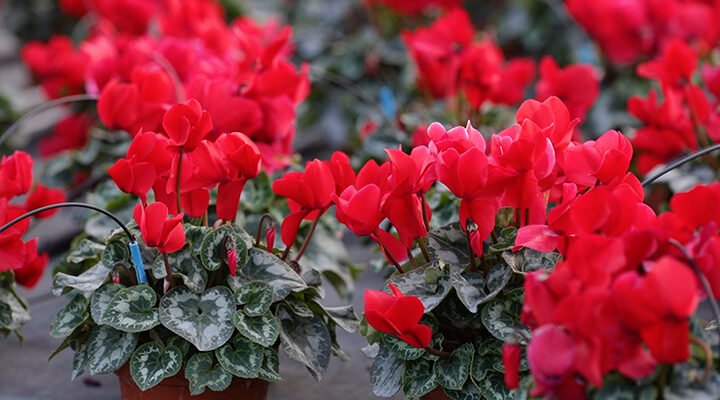
Cyclamen is a small perennial plant that bears flowers placed at the end of long vertical stems, raised above the foliage. On the market we mainly find cultivars originating from Cyclamen with peachavailable in colors ranging from white to red, through shades of pink and fuchsia, sometimes variegated. The flower is not always fragrant.
It is often grown as a houseplant and is particularly popular during the winter and Christmas periods, a good time to admire it in bloom.
Cyclamen care
What exposure to give to Cyclamen
If grown inside our homethe Cyclamen prefers one intense but indirect light during the winter. In fact, if placed too close to the windows, the sunlight combined with the mild temperatures of the house causes typical yellowing which appears on the leaves facing the window
If grown outdoors, cyclamen also tolerates direct winter light well.
In the warm months the tuber goes dormant and can be stored in a cool, dark placewith good air circulation.
What temperature does Cyclamen want?
The ideal temperature for cyclamen ranges from 4 to 20°C.
Cyclamen is a plant that it doesn’t like high temperatures very much. In the summer months it goes dormant and resumes its vegetative activity (then followed by flowers) when the season cools, typically in autumn.
The domestic environment offers shelter from the strong heat and in many cases the Cyclamen plant may not go completely dormant, only losing some leaves.
IFrost irreparably damages the tuber which must therefore be protected from too low temperatures. Another enemy of Cyclamen is humidity: it is a plant that is very sensitive to the onset of mold and consequent rot; better then avoid excessively humid environments and always guarantee a good level of ventilation.
How to water Cyclamen
During the vegetative phase the soil must be watered whenever the first few centimeters are dry; it is important to avoid wetting the leaves or the point where the stem meets the roots to avoid the onset of rot. An excellent method of wetting Cyclamen involves capillarity irrigation which allows you to avoid wetting the leaves and tuber.
During the rest period it is sufficient to guarantee a light humidity to the soil, providing light wetting only if the soil is completely dry.
Which substrate to choose for Cyclamen
The ideal substrate is soil fresh, light, rich in organic substances and well drained, with a slightly acidic pH.
The use of high quality potting soils such as One and One+ is recommended.
When to repot Cyclamen
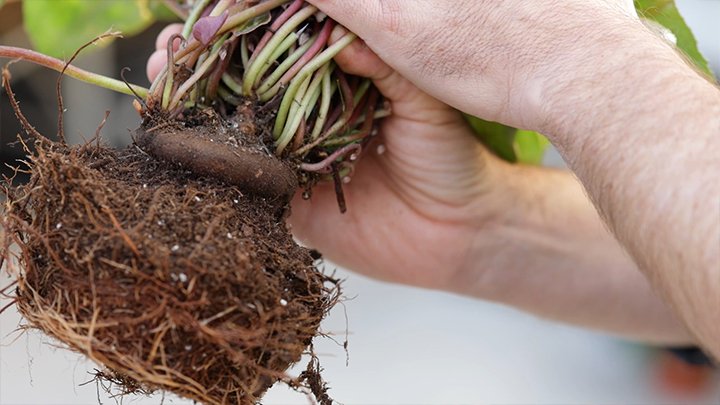
This plant would do repotted annuallyand it is preferable to do this operation when the Cyclamen is in the vegetative rest phase.
The bulb grows and tends to flatten, becoming too large for the vase in which it is located, this is the parameter to control when repotting.
How to fertilize Cyclamen
Cyclamen must be fertilized during the winter (therefore during the vegetative phase), with liquid fertilizer at Bass nitrogen contentcombined with the wetting water following the doses on the label. During rest it is not necessary to fertilize.
In particular we recommend these two fertilizers from Cifo: for flowering plants and for acidophilic plants.
How to propagate Cyclamen
You can run the cutting from the stem but it is a difficult process as these take root with a certain difficulty.
I seeds they can be planted at the end of summer to flower in the winter of the following year (about 18 months later), but it is necessary to pay attention because often the Cyclamens that we find on the market are hybrids and this leads to infertile seeds.
How to clean Cyclamen
Cyclamen does not require major pruning, it is enough remove dead or yellowed leaves as they arise. In the same way, even faded flowers can be removed, in order to prolong the flowering period.
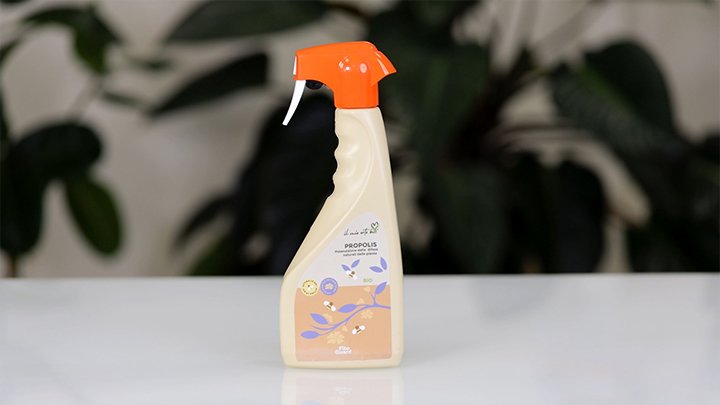
When it is necessary to disinfect after removing a stem, the use of propolis is recommended.
Cyclamen parasites and diseases
Cyclamen can be subject to attacks by botrytis (grey mold), which is created in conditions of poor ventilation. In this case it is important to clean the plant well and give it a more ventilated position.
As regards insects, some problems can arise from thrips, to eradicate them we can use the usual Mio Orto Bio emergency response mixture, also useful against moth larvae (also enemies of Cyclamen), scale insects and aphids: in 1l of water an intervention mixture composed of: 10 ml of Soft Soap, 250 ml of Nettle and 10 ml of Neem Oil.
And then one mixture for prolonged coverage: 10 ml of Ottomix Oil, 200 g of Recidal Sil and 10 ml of Soft Soap.
How to make Cyclamen bloom
Sometimes home-grown Cyclamens are thrown away at the end of the growing season, but in reality it is It is possible to make them bloom again year after year. To encourage reflowering during the vegetative period, simply cut the dead flower stems at the base and do the same with the yellowed leaves.
When the plant begins to lose its leaves it means that it is going into vegetative rest, in this phase it is important to reduce the watering so that the soil begins to dry and is not too humid, avoiding the risk of causing the tuber to rot.
Common problems with Cyclamen
The Cyclamen is wilting/has faded colours
The problem is probably to be found in the temperature. Cyclamen will grow during the coldest months of the year, as it is not a heat-loving plant you will not see it flowering in summer. Consequently, to continue to have a beautiful plant it is necessary keep it in a cool, bright area of the house.
Many leaves are turning yellow
Yellow leaves are quite common during spring, but if you start to see them earlier it is likely that something is to blame. too hot environment or excessive wetting of the tuber which has started to rot.
Rotten tuber
This often happens when the soil is left too wet for too long or due to an excessively low temperature. If the rotten part is small it can be cut, while if the rot is extensive it cannot be remedied.
Poor growth
Cyclamen do not like direct sunlight, however they still require fairly intense light to be able to grow, so if development proceeds slowly it may be the case of move the plant to a brighter area.
Deformed leaves and flowers
This problem could be a symptom of ainfestation by mitesalthough in reality it is not that frequent and therefore before considering this hypothesis it would be better to be sure that there are no other possible causes.
We know Cyclamen
Cyclamen is one tuberous perennial plantwhich means that the vegetative part dies during the summer months and then regrows when autumn arrives.
The flowers have shades that vary from pink to purple to red and to white. The leaves are heart-shaped and green in color, often with silver veins.
It has a compact shape with flowers that develop at the end of rather straight stems which have the particularity of being curved at the terminal part, then the flower, when it blooms, opens and takes on its typical morphology.
Taxonomic description
Cyclamen (scientific name Cyclamen) is part of the Primulaceae family.
Habitat
Cyclamen are mostly located in the areas around the Mediterranean basin.
Il Cicalmino is not pet-friendly
The Cyclamen unfortunately they are not great friends of our four-legged friendsthey are in fact toxic to both dogs and cats due to the terpenoid saponins. The clinical signs are: salivation, vomiting, diarrhea and, following the ingestion of large quantities of tubers: cardiac rhythm abnormalities, convulsions and death.
latest posts published
4 ideas to protect a summer kitchen from the sun

Why choose a roll-up pool cover? Advantages and disadvantages
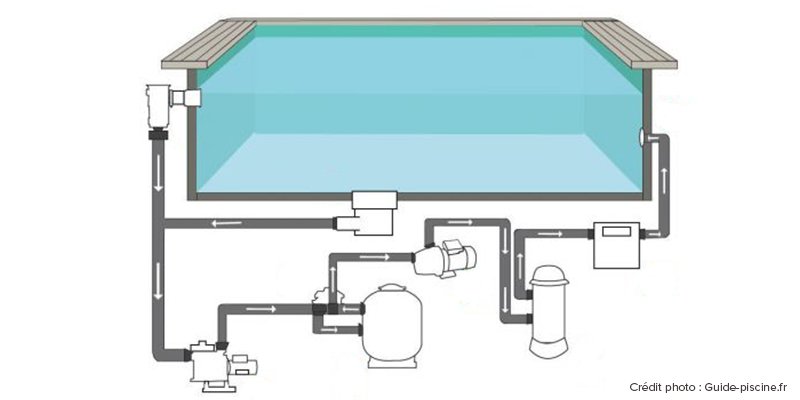
12 questions/answers on swimming pool filtration

Transform your garden into a bohemian and natural corner

Organize your balcony and terrace with a small garden furniture
Volcania EDA flowerpots to decorate your terrace or balcony

Which XXL pots to choose for an olive tree or a palm tree?

Our Top 3 for perfect lighting!

Which above ground pool should I choose based on my needs and budget?