
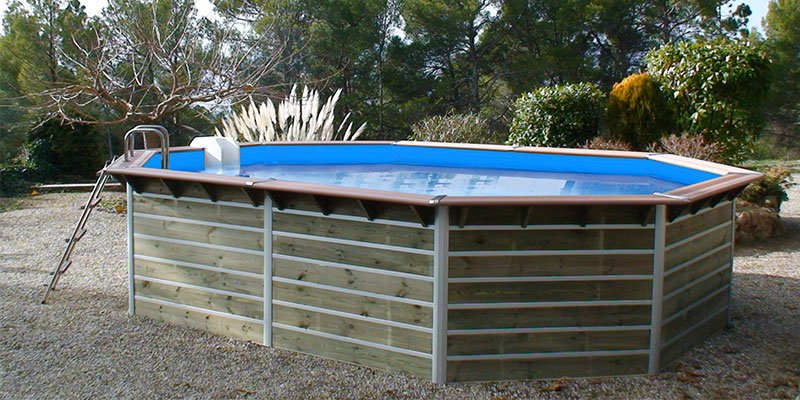
When buying a swimming pool, you need to think about it disinfection. The pool water must be filtered and disinfected from microorganisms brought by man and nature. Since you won’t be changing it every week, you will have to invest in treatment products and respect some essential rules.
You are here because you have chosen to disinfect your pool water with chlorine, the treatment product the most widespread et the cheapest. When using the pool for the first time (immediately after assembly), adjust the pH, shock treatment and filter the water for 24 hours (adjust according to water volume and product recommendations). You can then apply the following rules.
Different chlorine treatments
There are 3 families of products, to be used according to your needs:
- Chlorine in regular treatment, which dissolves slowly, most often in the form of pebbles.
- Chlorine in regular slow-dissolving multipurpose treatment, most often in the form of pebbles.
- Chlorine as a shock treatment, to be used occasionally.
Advantages
- Excellent water filtration
- Easy to use
- The least expensive
Disadvantages
- Strong smell
- Irritating to eyes
- Chemical
Don’t want to use chlorine? Discover the other possible treatment modalities!
Treatment plan
Depending on the type of product and the brand you use, the doses are not the same, follow this advice by respecting the doses prescribed for the products you use.
1. Adjust the pH
The pH must be monitored to guarantee a pleasant and non-aggressive bath for the skin but also to guarantee better effectiveness of the chlorine. In fact, its performance depends above all on pH.
>> The pH must be between 7 and 7.4.
Please note:
- At a pH of 7, chlorine is 80% effective.
- At a pH of 7.4, chlorine is 50% active.
How to adjust pH? Use pH minus or pH plus to adjust the pH level. If necessary, the pH level should be adjusted weekly.
When? Do a check every week with tests and adjustments based on the results. To add less or more pH to your pool, dilute the product in a bucket of water and pour it into the water.
2. Regular disinfection of water
To keep the water healthy throughout the season, favor slow treatment. Regular disinfection guarantees bathing comfort and clean water, free of microorganisms that pollute the water and which could cause the appearance of algae.
You can use multifunctional chlorine or not.
Please note:
If you choose to use multipurpose chlorine, you do not need to perform steps 3 and 4. However, check the water regularly, especially during heavy use.
When? Choose the form of chlorine that’s best for you. The simplest and most practical is in the form of pebblespre-dosed, slow diffusion. Depending on the volume of water in the pool, use 1 or more pebbles 1 time/week. The chlorine is introduced into the product’s skimmer or floating diffuser.
3. Anti-algae and clarifying
Antialgae, as the name suggests, is a product that prevents the formation of algae. Used as a preventive treatment or in case of algae already present.
The clarifying agent, for its part, helps keep the water crystal clear.
When? These two products should be used 1 or 2 times a monthdepending on the heat and the number of people in the pool. They are poured directly into the water.
Please note:
You can also add the anti-algae treatment once a week, preventively, at low doses.
4. Flocculation
Flocculation products improve filtration. The flocculant is only compatible with the sand filter. If you have a cartridge purifier, use a clarifier, which will have the same effect.
When? Add the flocculant 1 or 2 times a monthdirectly into the water.
5. Shock treatment
Rapidly dissolving chlorine shock should be used occasionally:
- Restarting the pool
- To quickly increase the chlorine level
- Pond wintering
- Cloudy or green water
- During extreme heat and/or high attendance
Dosage
The chlorine level of the pool must be maintained between 0.5 and 1.5 mg/l. This rate is identified during weekly water testing. If it is not within this range, adjust it by adding a little chlorine (tablet, powder or chlorine shock).
Please note:
Don’t put chlorine in the water but put chlorine in the water.
latest posts published
4 ideas to protect a summer kitchen from the sun
Why choose a roll-up pool cover? Advantages and disadvantages
12 questions/answers on swimming pool filtration

Transform your garden into a bohemian and natural corner

Organize your balcony and terrace with a small garden furniture
Volcania EDA flowerpots to decorate your terrace or balcony

Which XXL pots to choose for an olive tree or a palm tree?

Our Top 3 for perfect lighting!

Which above ground pool should I choose based on my needs and budget?