
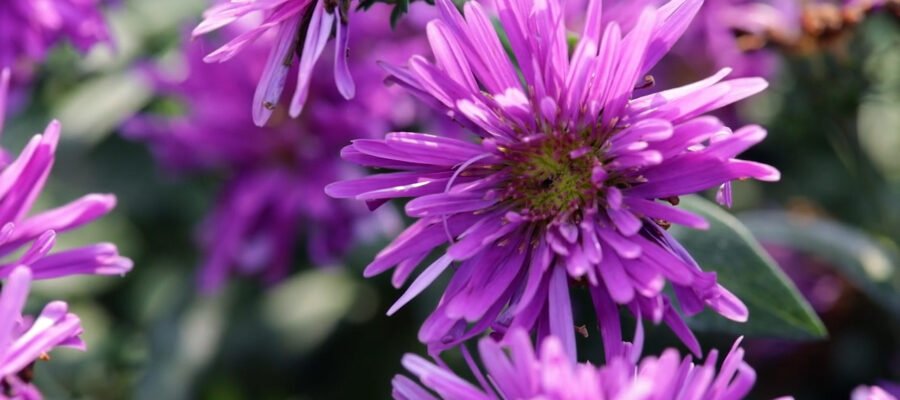
«…because in the meadows there is a flower, which the farmer calls «amello»…»
Asters, also known as Septembers, are magnificent perennial flowers that can boast a truly enviable range of colors ranging from white, pink, purple, blue and red. Between summer and autumn (August/September) they adorn the gardens, adapting to every style and giving breathtaking shades.
A small premise that must be made is that previously the Aster genus included other types of plants such as Kalimeris, Symphyotrichum and Callistephus, which have now been divided into different genera. However, in this article we will keep them enclosed, as the treatment is the same.
Ready to meet them? We’re almost there, but first a curiosity that deserves to open the article: the Latin phrase that you can read at the beginning is the first reference to the genus Aster amellus ever made and it can be found within the poem Georgics written by Virgil!
Asters are quite resistant plants that adapt well to most environments, the only obstacle being very heavy soils and summer drought.
What exposure to give to Asters
They particularly appreciate the exposure of full sunbut they can also survive in harsh conditions light shade.
In too shady areas the risk is not to see them flower.
What temperatures do Asters want?
Most asters are perennial resistant to low temperaturesdown to approximately -15/-20°C. The real enemy of these plants during the winter is more humidity than cold.
How to water asters
When the Asters are in the ground they must be watered during periods of prolonged drought. Furthermore, it is recommended to do less but deeper wetting, rather than frequent but little watering.
In pots, however, watering must be done more regularly, when it is hot it may be necessary to water them every day. More or less the rule to follow is that of nNever let the soil dry out completely and/or that does not remain dry for more than 1 or 2 days.
It is recommended to water the Asters trying not to wet the leaves, because this could cause the growth of mold or fungi.
The use of terracotta pots is not recommended with Asters, as they could cause the soil to dry out quickly.
Which substrate to choose for Asters
Septembers grow in most moist, well-draining, fertile soils. If you only have sandy soil, it is advisable to add some well-decomposed organic material. They appreciate the soil slightly acidicwith a pH between 5.8 and 6.5.
As always, we recommend the One line, perfect for Asters too!
How to fertilize Asters
September plants placed in open ground usually do not need regular fertilization. It is sufficient to mulch the plants in the border during the spring.
However, Asters will benefit from liquid fertilizer for flowering plants or slow release fertilizer given in March, June and September. For a leap in quality, administer some Bio Oro!
How to Propagate Asters
The propagation of Asters can occur through division of the tufts, cutting and seed.
At the beginning of spring it is advisable (approximately every 3/5 years) to proceed with lifting and dividing the Aster tufts. It is an operation that is best carried out around March/April, with the aim of keeping the plant healthy and strong.
Sowing is very suitable in the case of Chinese Asters (Callistephus chinensis) and can be done in spring.
Propagation via cuttings can be done both in spring and early summer, to allow rapid growth. To carry out the cutting, you need a stem of about 10 cm, on which only the upper leaves are left, to allow photosynthesis.
How and when to prune Asters
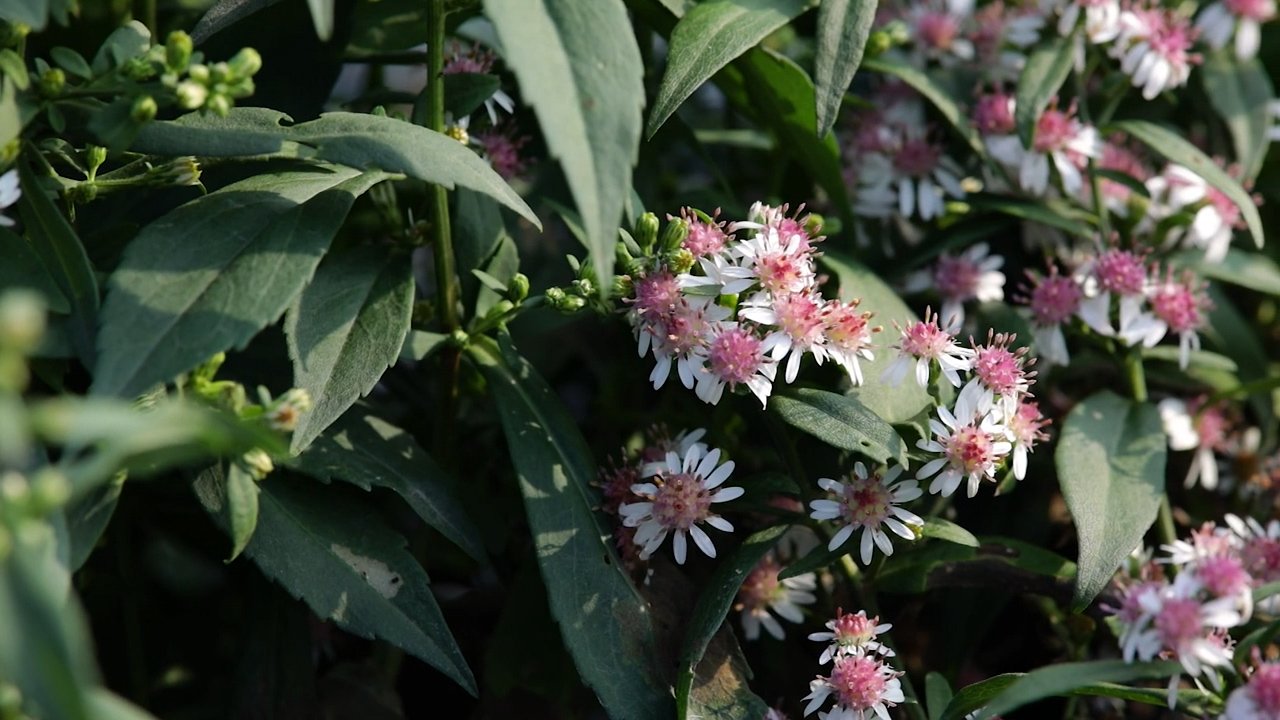
Removing the deadhead can encourage new blooms, but in reality Septembers bloom profusely without outside help. A hand instead could be useful for example to the Chinese Asters (Callistephus chinensis), which grown as summer annuals will reach the maximum quantity of flowers if the flowering is cut regularly.
The faded heads can be left on the plant to serve as food for birds and shelter for other animals.
Some practice the Chelsea chop (we have already talked about it here), to be performed after the summer.
Aster parasites and diseases
Septembers are usually robust and resistant plants but can be subject to attacks by thepowdery mildewespecially if the plants are grown on soil that retains moisture.
Powdery mildew can be recognized by the white, powdery coating that appears on the leaves.
Against powdery mildew I recommend a mix, dissolved in 1 liter of water, composed of:
How to winter asters
In autumn, when the drop in temperatures begins to be felt, the Asters will stop flowering. In this period it is advisable to mulch the plants placed in the ground, so as to protect the roots during the winter period.
Stunted growth and yellow leaves
These could be symptoms attributable to root rotperhaps caused by excessive watering or a pot with poor drainage. Usually in these cases the center of the Aster will appear brown and sunken and the stem will be fragile, prone to breaking easily.
Unfortunately, root rot is an extremely serious problem which, if diagnosed late, will leave the plant with no way out. If it is discovered in the early stages we recommend digging up the asters, washing the roots in clean water, cutting off any that appear to be damaged by rot and then replanting them in well-draining soil.
Yellow/brown leaves
Yellow/brown leaves that then tend to dry out are an indication of problems related to droughtusually the flowers will also be affected by the situation, as they will begin to droop and wither.
To solve the problem, provide uniform irrigation and also check that the soil can properly handle the water administered.
Aesthetically, the Asters, despite their simplicity, give a lot of satisfaction, they appear as tufts of green leaves from which erect stems surmounted by flowers emerge.daisies” which can be white, pink, lilac, purple, blue or red and, very often, have a yellow center.
Most Asters bloom in summer and autumn, the height of these plants is from 20 cm to 2 m, depending on the cultivar.
I am easy to grow perennialsevery year they will return to flower as soon as the temperatures return to mild after the winter, Asters live for about 4-5 years, depending on care and environmental conditions. In harsher climates (for example in the mountains), they can be grown as annuals.
Asters also produce a fruitan achene approximately 2.5-3 mm long which reaches maturity at the end of summer.
Taxonomy
Asters belong to the Asteraceae family. With around 23000 species, sorted into 1535 genera (approximately), this family is the largest in the green world.
Septembers bond well with plants such as: Achillea millefoliumclimbing roses, nasturtium, marigold, Leucanthemum x prideum, Calamagrostis x acutifloraChrysanthemums, Echinacea, asparagus, Liatris spicataZinnia, Blood geranium, Azaleas.
Etymology
The name «Asters” comes from Greek and means, very poetically, “star flower“.
Habitat
Asters are distributed throughout much of the world, particularly in Europe, Africa, Asia and North America. About ten species are native to Italy!
Curiosity
As we said at the beginning, many Asters have changed their names, this is because new technologies have allowed botanists and scientists to better analyze the DNA of plants and to reevaluate some groupings that had been made previously.
latest posts published

How the chair influences the decor of a space

Ideas for decorating your home for Christmas

Winter fabrics for home decoration: ideas and advice

Furnishing farmhouses and barns: rustic elegance in Tuscany

Flos Portugal luminaires: sophisticated Italian design
Pedrali Outdoor: the complete guide to Italian furniture and design

Rugs and carpets – Tailored elegance and comfort

Design of the layout of the Miramaia Shopping Food Court

Comfortable chair or correct posture?