
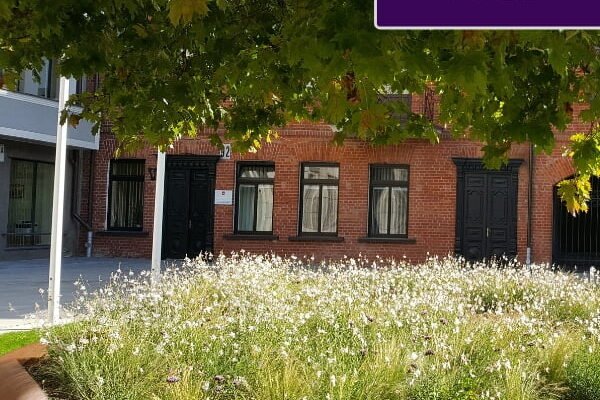
The Kaunas Municipality flower garden looks completely new: some appreciate the changes, others have objections. While Facebook is buzzing with discussions, I decided it was time to get to know each other The fire occurred on Saturdaywho is responsible for the public gardens of the city of Kaunas, and discover firsthand the idea of this flower garden:
Why are raised beds so massive? Why choose these plants? All questions were answered by Ugnė Šegždiene, Kaunas. head of the environmental protection department of the municipality, specialist landscape architect. If the video format is inconvenient, read his answers below.
Who came up with the idea of the frame for the flower garden
The Kaunas Municipality Flower Garden is located on Laisvė Boulevard, many people pass by and first notice… the massive brown banks of the flowerbeds. Not everyone likes them: these raised beds are the most common criticism.
Where did this idea come from?
Shapes and layout of the beds made Šarūnas Kiaunė’s design studios architects who designed the entire Laisvės al. the complex. U. Šegždiene states that the idea of raised beds is a decision of the architects, this choice was determined by the need to create an accent for this part of Laisvė aleja, to highlight it.
In order for the view to blend well with the lines of the renovated Laisvė Avenue, the flower garden was created with regular geometric shapes. However, as Ugnė says, art and architecture will always be the subject of discussions and different opinions.
Several raised beds
The flower garden of the municipality of Kaunas stands out not only for its grandeur, but also for the material used for the flowerbeds: this rusty metal (corten). Such a metal has been popular in Europe for several years, so it is not surprising that it appeared here too. It’s up to you whether it fits here.
It turns out that they have no bottom, so it’s not a closed system, reminiscent of saucepans. About 30-40 cm of fertile topsoil is poured into these beds and a drainage layer is placed under it, so that all the water flows deep into the subsoil. Ugnė argues that we could even plant a tree in the middle of such a bed: there would be enough space for the roots, but in the long run we would run out of nutrients.
Why choose such plants?
The architects created the foundation and U. Šegždiene’s task was to ensure that the flower garden of the Kaunas municipality was planted.
This is where the second wave of discontent hides. Traditionally minded Kaunasians were more likely to come across huge corten beds, while enthusiasts of the naturalistic style were impressed by the annual flowers. Perennial plants are planned for sustainable greening of cities in Europe, which require fewer resources (water, fertilizers, maintenance personnel, funds for maintenance of flower gardens and continuous renewal), but the new flower garden of Kaunas Municipality, although it looks new, is planted with plants that do not overwinter.
Ugnė argues that there were several reasons for this choice:
- First of all, the flower garden is planted at the end of summer. A good and effective image was needed immediately. For this reason, gaura (lat. Oenothera Lindeimergi / Gaura Lindheimeri), Patagonian verbena (lat. Verbena bonariensis) and horsetail (lat. Stipa tenuissima) were chosen. Although these plants are classified as perennials, they do not overwinter in our climate zone.
- Secondly we wanted the flower garden to undergo a transformation, so that it changes from spring to autumn, is interesting to look at, colourful.
Since the conditions in the flowerbeds also allow the cultivation of perennials, the second reason did not seem sufficiently argued to me, so I wonder what is planned for the future.
What the Kaunas Municipality flower garden will look like next year
In the spring of next year, this flower garden will surprise you again with a different view. For now Ugnė does not reveal the details, he wants to leave the intrigue, but he has already said that in early spring the flower garden will delight with flowering, which will be the gift of the first bulbous flowers and decorative garlic that will bloom a little later.
Well, once spring is over, the annual summer flowers will be planted again. As residents and visitors of the city get used to this flower garden and its concept, a different image will gradually be created. In the future it is expected that it will also be planted with perennials.
Changes in greenery in Kaunas
I was wondering what other interesting plant-related projects are developing in Kaunas? The landscape architect says we should pay attention to the greenery near Kaunas Castle. Although it was created in extreme conditions during the heat, it will not take long to green up and decorate spaces.
U. Šegždiene asks for patience from the inhabitants and guests of Kaunas. Annual plants are increasingly replaced by perennials, but the best picture will be seen only 2-3 years after planting the plants.
He gives the example of the ring of via Jonava: at the beginning many did not understand why the tufts were planted, but now, after a few years, in the second half of the year, all the beauty of the miscanti is revealed, which forms the backdrop to the sculptures of the knights of the rotunda.
My rating
I thought, I can’t help but put my money here. Don’t take this as an expert’s opinion, but as my personal opinion that I want to add when talking about these plants. Here are some of those observations:
- The corten beds didn’t seem huge to me, as they matched well with the similar colored building facade in the background – check out the video, it really matches. Although corten is no longer the trendiest thing in the landscaping world, in Lithuania it is still a new-looking material, which fits the color in this place;
- One designer’s observation was right: If the plants were taller, the beds wouldn’t look so massive. So, fearing a conservative appearance, taller plants could be chosen. Without fear: do not choose;
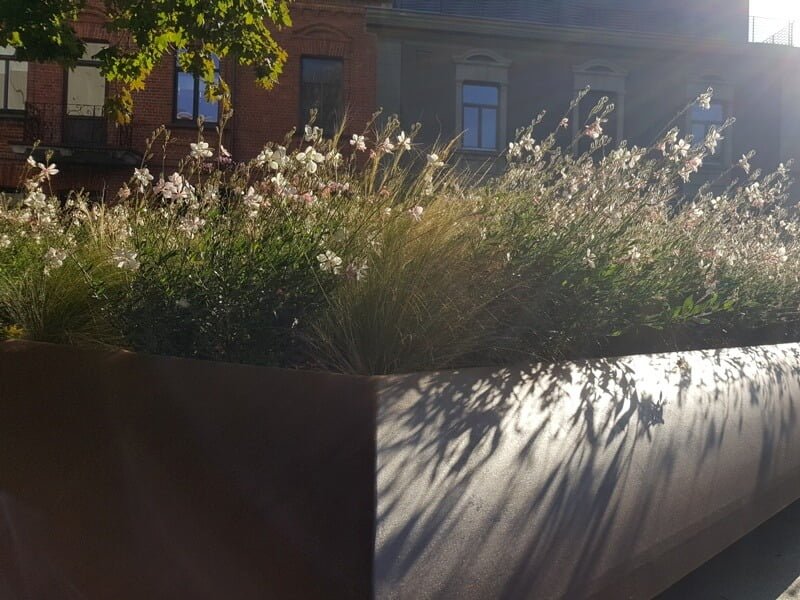
- I evaluate whether green is suitable for people. Here everything works: people walk between the beds to take photos, the nearby benches serve as meeting points (I saw several people waiting and then leaving together), Polish tourists stopped to discuss the flower garden and everyone took photos nearby. As Ugnė says, this is not a museum behind glass.
- I evaluate whether green is suitable for nature lovers. Hedgehogs won’t wander here, but there are already countless bees buzzing around. While I think perennials would be better in a location like this, choosing broom that attracts bees doesn’t seem like a bad alternative;
- Originality: It’s definitely here. Perhaps that is why the flower garden has received so much attention. At the moment, the meadow buzzing with pumpkins in the corten flowerbeds looks unconventional, you would recognize this flower garden from the photo if you had seen it at least once. We will see how much originality the flower garden will retain, but today I invite you to celebrate diversity.
- The same applies to other new green areas in Kaunas: the riders with miskantas on Jonavas Street seem very beautiful to me, but at a busy intersection they convey even more aggression and vigor. However, the character of that vegetation is completely different from that of the municipal flower garden – and that variety is fantastic!
latest posts published

How the chair influences the decor of a space

Ideas for decorating your home for Christmas

Winter fabrics for home decoration: ideas and advice
Furnishing farmhouses and barns: rustic elegance in Tuscany

Flos Portugal luminaires: sophisticated Italian design
Pedrali Outdoor: the complete guide to Italian furniture and design

Rugs and carpets – Tailored elegance and comfort

Design of the layout of the Miramaia Shopping Food Court

Comfortable chair or correct posture?