Nowadays, with 80% of water tables below average, an increasing number of gardeners are investing in water collectors. Rainwater harvesting is frequently the only option available to everyone to maintain their vegetable garden and drinking water during dry spells. There are numerous varieties and a wide range of exterior designs for water tanks, aerial or subterranean recuperators, amphora, and barrel-shaped devices.
How to choose a rainwater harvester?
Evaluate your water needs
The first step, before choosing your water collector, is to evaluate your rainwater needs. That is to say, know the future use of this collected water. For watering potted flowers on the terrace, for the vegetable patch, for the garden or for cleaning garden furniture or the car. The amount of water varies greatly.
In addition to its use, you will also have to evaluate the frequency of needs. If you’re watering a vegetable garden, chances are you’ll need a regular amount of water.
Today the capacity of the best-selling water collectors is between 300 and 500 litres.
The different models of water collectors
Overhead water recovery tanks : This type of model is very popular. Both for the tank volume and the price, they are often anyway not very aesthetic and made of medium quality plastic. These cube-shaped tanks are perfect for watering a vegetable garden.
Water tanks to be buried : this type of water collector is rarer and often corresponds to mixed use garden/house. Much more expensive than traditional tubs, they also require some precautions in the garden and regular maintenance.
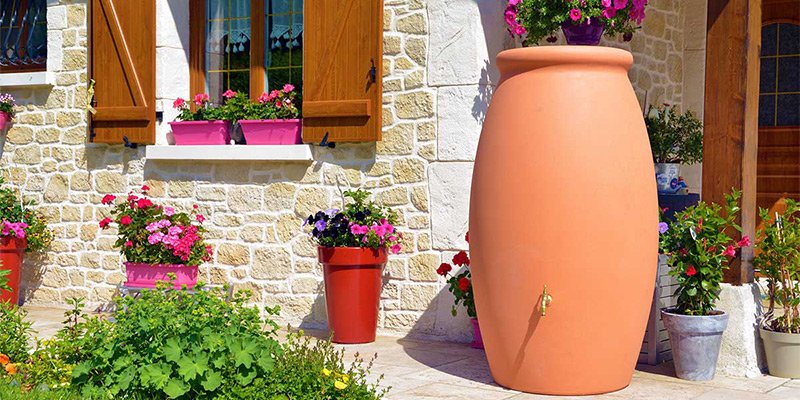
Aerial water collectors : Very popular, these water collectors exist in many forms. From the most designer to the most classic, their capacity varies from 100 to 600 l. Among these recuperators we find jar or barrel shapes, but also more modern stone or vase shapes.
Concrete tanks : These tanks are rarer because they are very expensive. Their use is more reserved for large gardeners who water needs are very important.
Read our article: How to maintain the rainwater collector?
Determine the location of the water collector
Location is a determining point when choosing the water collector. In fact, depending on the space available, you will need to choose a binder with capacity, but also with an adequate shape.
For example, some round shapes cannot be or will be difficult to lean against the wall. You also need to take into account the distance between the gutter and the tank and provide a corresponding length of pipe.
The sun is also an important factor. If the location is in full sun, we recommend you choose an anti-UV and opaque tub to limit the development of algae and bacteria.
Finally, if you live in a very hot or very cold region, we recommend opting for a rotationally molded water collector, which is more resistant to temperature variations and external conditions.
Blown or rotomoulded tanks, what are the differences?
There are two types of techniques used to manufacture a plastic water collector: blow molding and rotational molding.
THE blowing it is a technique which, by exploiting air pressure, allows you to model a previously heated material.
THE rotomolage it is a process that allows the transformation of plastic materials (powder) into a steel or aluminum mould. In simple terms, the mold is filled with plastic materials then rotated and heated. The plastic will thus take the shape of the mold.
To choose your water collector, a tank designed using rotational molding offers better mechanical strength than blow molding. In fact, this type of tank does not have any welding. They are highly resistant to impacts, temperature variations and frost. Unlike blown tanks, they do not require emptying in the winter. The disadvantage is that its price is higher.
Read our article: The advantages and disadvantages of a water collector
Features to consider before purchasing
The absence or absence of the water collector : Not all rainwater tanks are sold with water collectors. Sometimes it will therefore be necessary to plan the parallel purchase of a collector. This can be equipped with an automatic or non-automatic overflow, a filter grid, or a summer/winter position which allows both to send the water into the tank and to convey it towards the sewer.
The possibility of pairing water tanks : tank coupling is a quick way to multiply the amount of rainwater collected from the same gutter. This installation is quick and easy, also achievable for most tanks. All you need to do is purchase a connecting hose (sold separately) and drill holes in the two tanks.
With drain hole or not : the drain hole it is not necessarily present on all tanks. Often pre-drilled, manufacturers leave the choice to users. In fact, for all tanks, complete emptying is not mandatory.
The connection to the left or right : Depending on the location of your gutter, you will have to choose a connection to the left or right of the tub. In principle, most current rainwater collectors are pre-drilled, which allows you to choose which side to connect to the gutter.
The round or square shape of your gutter : depending on the shape of the gutter it will be necessary to choose a suitable collector. That is, there are water collectors that can be adapted to different shapes of gutters. I am cuttable depending on the shape and size of the gutter.
The faucet:made of plastic or brass, it is already installed or its hole is pre-drilled.
latest posts published
Choose a water collector wisely! All our advice!

How to attract and feed birds even during the winter?
Summer irrigation – Guide to good practices

4 easy recipes with autumn fruit and vegetables #1

How do I calculate the filtration time of my above ground pool?

The robot lawnmower: why you will like it

How to choose a pool heat pump? Power, COP, criteria…
How can I clean the filter cartridge of my Intex inflatable spa?

Healthy spring shrubs